High Speed Training writes an ice-slurry window of −1 to +1 °C and a boiling-water window of 99 to 101 °C for a food probe. That is a field check. It does not calibrate the instrument, it does not issue a UKAS certificate, and it does not make a USB logger conform to EN 12830.
What do the kitchen sources ask for in an ice check?
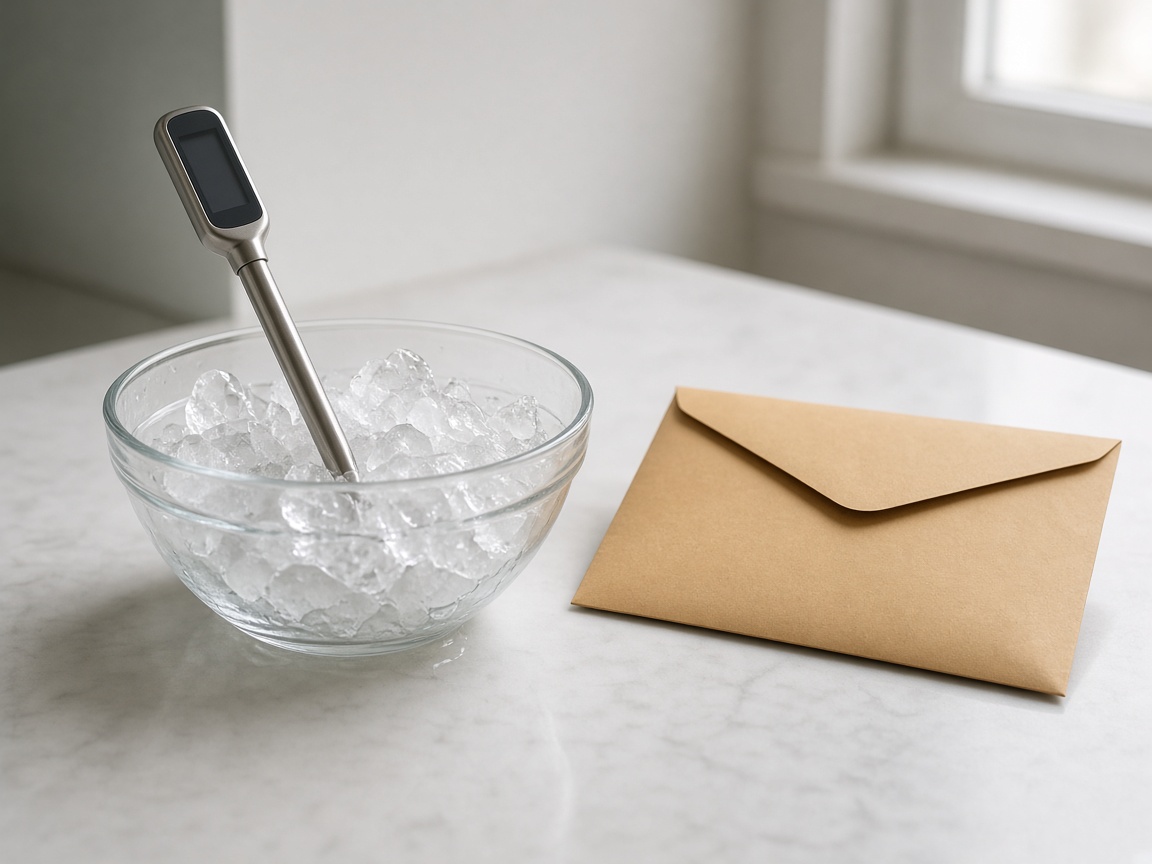
The High Speed Training thermometer note tells the reader to pack the probe in melting ice, avoid the container wall, and look for a reading near 0 °C; the written window is −1 to +1 °C. Boiling water is written as 99 to 101 °C. The same hub’s core-temperature article treats ice and boil as the field check before a cooking record. SFBB is the official England-and-Wales pack that sits behind those kitchen habits.
The hub also transcribes an FSA preference that a food thermometer stays within ±0.5 °C. That is a target attributed to FSA, not a result from this publication, and not a certificate.
Why are these three documents not interchangeable?
A field ice-point reading says: on this day, in this slurry, this probe indicated near 0 °C. A manufacturer inspection sheet is the maker’s outgoing test. A UKAS certificate names the object, the date, the uncertainty and the laboratory. Cambridge Refrigeration Technology’s EN 12830 page is a type-test and ATP-station explanation. A badge on a shop listing is not that report.
| Document | What it can show | What it cannot show |
|---|---|---|
| Ice-slurry note | Today’s field check against melting ice | Traceability or an EN 12830 type test |
| Factory paper in the box | What the maker printed for that unit | A UKAS scope or a later audit pass |
| EN 12830 / EN 13486 report | Type test or periodic verification of a defined recorder | That this week’s journey was acceptable |
What would an original ice-point page record?
Instrument identity, whether the whole logger or only a probe was immersed, time to a stable reading, the indicated value, and the reference if one existed. The conclusion stays “field ice-point check on this date”. It does not become “calibrated” or “conforms to EN 12830”.
Which sources does this note use, and what do they not prove?
Sources checked on 23 September 2026. Numbered references point to the original publishers. Their sample measurements are not Temp Logger UK measurements. Manufacturer, training and official material is identified separately. A shop catalogue sentence can name a model, but it does not establish the columns, the clock or a pass. This publication has not tested or certified any instrument in this note.
- High Speed Training Hub, A guide to food thermometers ↗Rachel Gordon, 26 March 2025. Ice slurry −1 to +1 °C; boiling water 99–101 °C; FSA ±0.5 °C target for a food thermometer; infrared is surface only. A field check is not a calibration certificate.
- High Speed Training Hub, Core temperature of food ↗Tash Blythe, 5 May 2021. Thickest-part probe placement; England time–temperature combinations; Scotland 82 °C; ice/boil field check. Free PDF log sheet. Course upsell is present. Not a USB-logger tutorial.
- Food Standards Agency, Safer food, better business (SFBB) ↗Official pack for small caterers in England and Wales. Diary and prove-it records. Not a logger specification. Scotland uses CookSafe.
- Cambridge Refrigeration Technology, Temperature recorders EN12830 ↗UK DfT ATP test-station page distinguishing EN 12830 type tests from EN 13486 periodic verification. A shop EN12830 badge is not this report.
No instrument in this note has been tested or certified by this publication. Evidence policy · Corrections
Write the conditions beside the reading.
The CSV has column headings and one empty row. It contains no fabricated sample readings.
Download temperature-log record ↓